Where title comes from — and what it means for a claim on Mars.
Long before there were deeds, there was the act of standing on a piece of ground and saying this is mine, and here is how I'll prove it. This is the real history of how that act became ownership — across two American coasts, the wild west, the Florida swamp, and the Amazon frontier — and what it tells us about claiming land on a new world.
By the Spaceclaims Registry~6,000 words · 25 min readJune 2026
📜
This is real legal and frontier history, told straight. It explains the reasoning behind our process — it is not a claim that any authority will recognize an off-world parcel. No legal title is conveyed on the Moon or Mars today.
We treat a land title as a piece of paper — a deed in a drawer, a record in a county office, a line in a database. But the paper is the youngest part of the story. For most of human history there was no paper at all, and land still had owners. The question every legal system has had to answer on every frontier is the same: when a person walks onto unclaimed ground, what exactly turns their presence into a right? The answer, almost everywhere and almost always, has started with possession.
To possess land in the old sense was to do something to it and on it: to clear it, fence it, build on it, plant it, live on it, defend it, and to be seen doing so by your neighbours. Ownership was a fact on the ground before it was a fact on file. The deed, when it finally came, did not create the right so much as record a relationship that already existed between a person and a place.
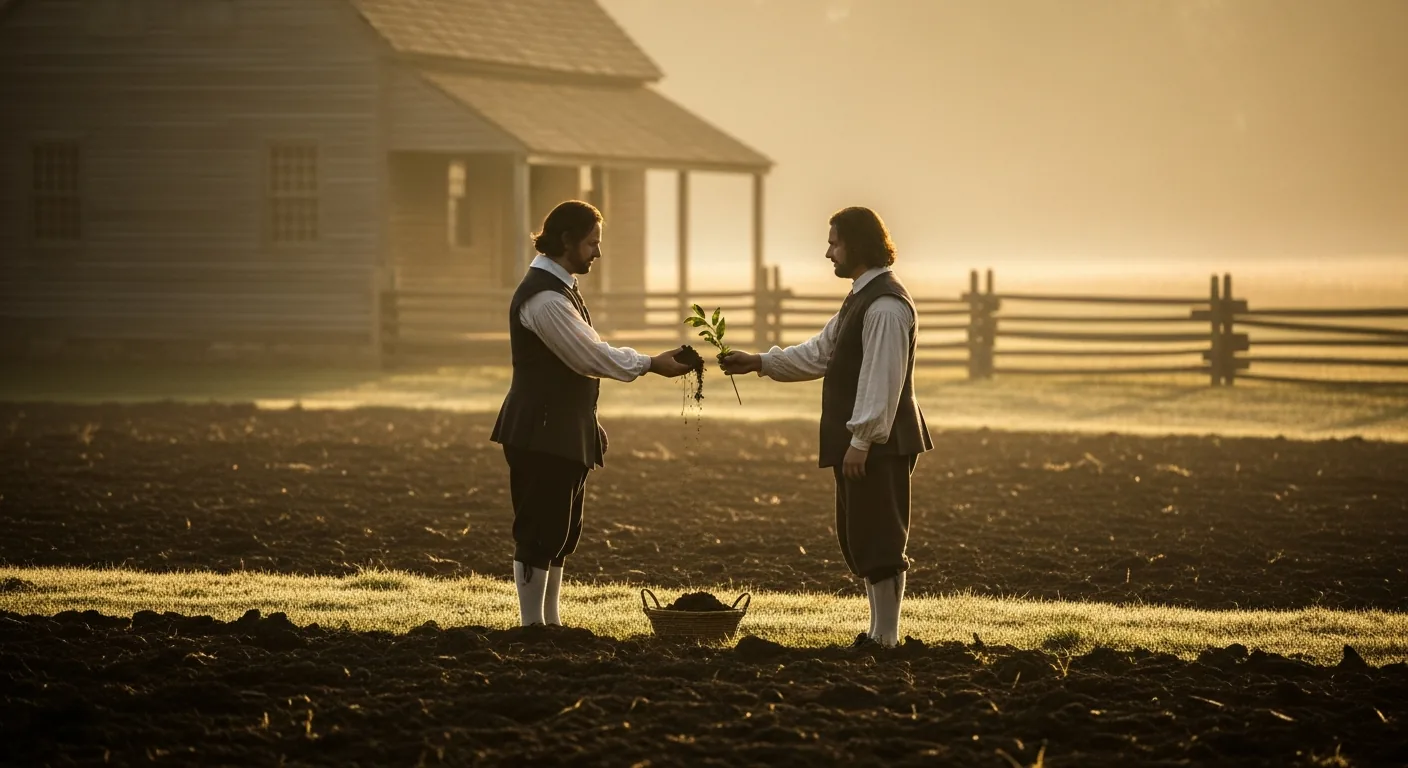
English common law — the root system of American property — made this almost literal. Before written conveyances became standard, land changed hands through a ceremony called livery of seisin, from the Old French livrée (delivery) and seisin (possession). The two parties would walk to the edge of the land itself, and the person giving it up would hand the person receiving it a clod of earth, a piece of turf, or a twig cut from the ground — a physical token of the soil, passed hand to hand, often before witnesses. That was the transfer. If the parties could see the land but not conveniently stand on it, they could perform "livery in law" by pointing to it from within sight. There was frequently no document involved at all; the act, witnessed, was the conveyance.
A handful of dirt, handed over in front of neighbours, once carried the legal weight we now assign to a notarized deed. The ceremony only faded after England's Statute of Frauds in 1677 began requiring writing for land transfers — and it was not fully obsolete until the nineteenth century.
Underneath the ceremony sat a principle that never went away: possession is the root of title. Its sharpest expression is the doctrine of adverse possession — the rule, ancient in English law and alive in nearly every American state today, that someone who occupies land openly, notoriously, continuously, and as if it were their own for long enough can ripen that possession into legal ownership, even against a paper owner who slept on their rights. Law, in other words, has always reserved a path by which the person actually using the land can come to own it. Paper is powerful, but paper that describes land nobody occupies has always been the weaker thing.
Hold onto that idea, because it is the spine of everything that follows. Every frontier we are about to cross — colonial Virginia, gold-rush California, the homestead plains, the Florida interior, the Amazon today — built its property system on the same foundation: get there, occupy in good faith, improve, document, and be recognized. The flags and the forms changed. The order of operations did not.
Livery of seisin. For centuries, English land passed by a clod of earth and a twig handed over at the edge of the field, witnessed by neighbours — possession made visible. The written deed is the recent newcomer in this story, not its origin.
Part two
The east coast: title that fell from a Crown.
When English settlers reached the Atlantic coast, they did not arrive in a legal vacuum — they brought a chain of title that ran all the way back to a king. In the English theory of land, the Crown was the ultimate owner of everything; private people did not own land outright so much as hold it from the sovereign under a form of tenure. In the colonies that tenure was usually the mildest kind, called "free and common socage" — landholding without feudal military duties, typically subject only to a small annual money rent. So the first American titles were, quite literally, gifts of the Crown, handed down through royal charters and proprietary grants to companies and favoured individuals, who then parcelled the land out to settlers.
The most consequential early experiment in turning bodies into titles was Virginia's headright system, created by the Virginia Company in its Charter of Orders, Laws and Privileges of 1618. The logic was brutally simple and would echo for the next three centuries: a colony is worthless without people on the ground, so reward whoever puts them there. Under the headright, anyone who paid the passage of a settler across the Atlantic received 50 acres of land per head — per "right" to a head, hence "head-right." Pay your own way, get 50 acres. Pay for your family and servants, get 50 acres for each. When the Virginia Company collapsed and Virginia became a royal colony in 1624, the Crown simply kept the machine running. Headrights were granted in Virginia until the state abolished them in 1779.
Against those grants the colonists owed quitrents — a small recurring payment to the Crown or proprietor, commonly on the order of two shillings per hundred acres, that "quit" the landholder of any other feudal obligation. Quitrents were modest in amount and enormous in resentment; collecting them was a perennial colonial headache, and their abolition was one of the quieter victories of the Revolution.
The Crown's pen. An early colonial land patent: calligraphy, a wax seal, a witnessed signature. On the east coast, the original root of a private title was a sovereign's grant — a document that flowed downward from a king to a company to a settler.
People love to ask which American deed was the first. It is a harder question than it sounds. Plenty of towns across Connecticut, Massachusetts and New York claim "the oldest continuously recorded deed," and those are charming points of local pride rather than a single settled fact — so we won't crown one here. But there is a clean, documented "first" once the United States itself becomes the grantor. After independence, the new nation began surveying and selling the public domain under the Land Ordinance of 1785, starting in the Seven Ranges of the Ohio Country. The very first federal land patent — a title issued directly by the United States rather than a king — was granted to a man named John Martin and dated March 4, 1788. From that document forward, an unbroken series of federal patents would convey the American continent, parcel by parcel, out of public hands and into private ones.
There is a harder truth woven through this section, and a registry that stakes its name on honesty has to say it plainly: the land the Crown "granted" and the United States later "patented" was not empty. It was home to Native nations whose own systems of possession and use were displaced, ignored, or extinguished by force and treaty to make room for the paper above. The settler title systems we are tracing were elegant machinery built, in large part, on dispossession. We trace how that machinery worked because it is the direct ancestor of modern property law — not because the frontier it conquered was the unowned wilderness its paperwork pretended. We will return to why that history matters for a place like Mars, which has no prior inhabitants to displace.
Part three
The west coast: title that arrived under another flag.
Travel to the other coast and the chain of title runs through a different capital entirely. California's first private land titles were not English or American — they were Spanish, and then Mexican. Under both regimes the governor could grant enormous tracts of land, the ranchos, to soldiers, settlers and prominent families. These were not small homesteads; a single rancho might run to tens of thousands of acres of grazing land, its boundaries described not by survey coordinates but by landmarks, oak trees, creeks and rawhide maps. By the time the United States arrived, much of the best land in California was already spoken for under grants written in Spanish.
When the U.S. took the Southwest at the close of the Mexican–American War, the Treaty of Guadalupe Hidalgo (signed February 2, 1848) made an explicit promise: the existing property rights of Mexican landholders would be respected. The promise was real. The follow-through was punishing.
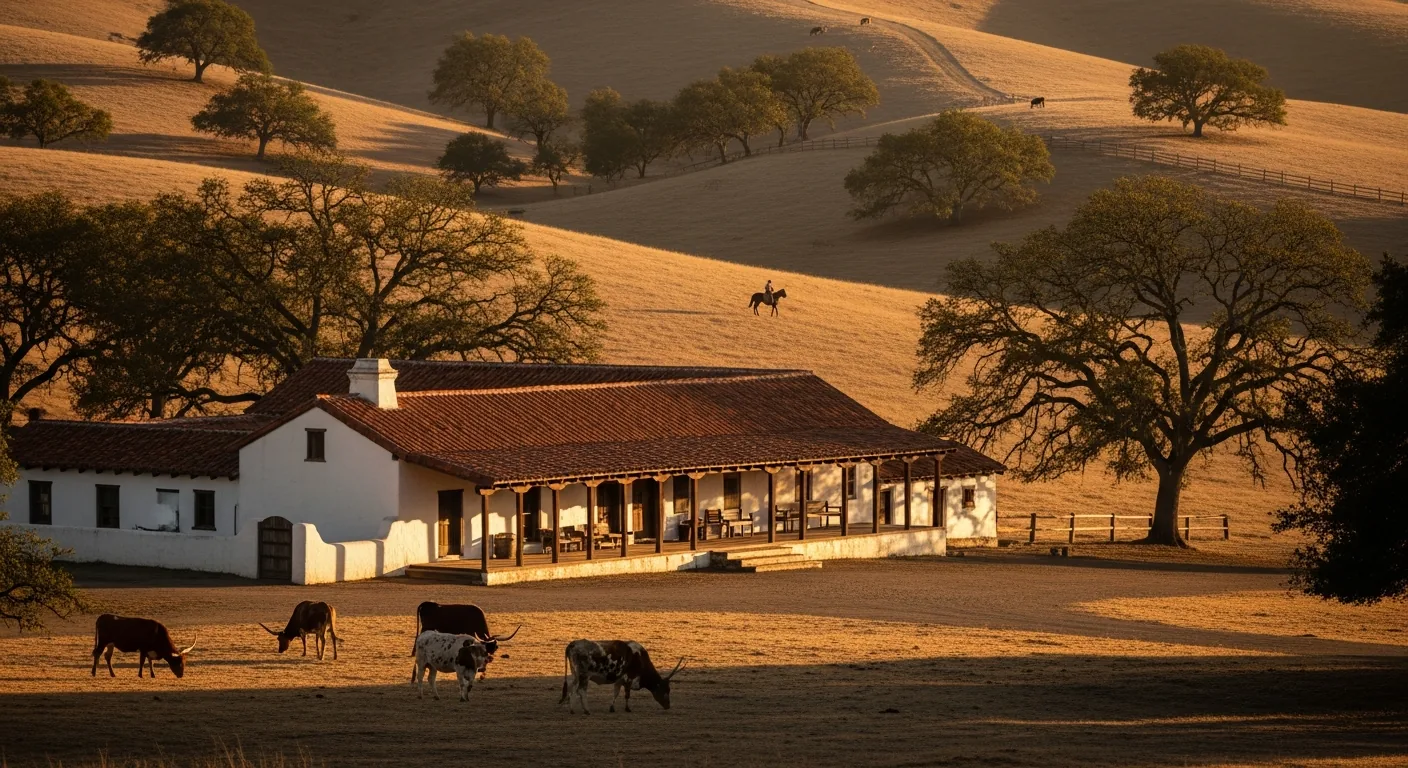
The ranchos. Before the United States, California's land was held under sweeping Spanish and Mexican grants. When sovereignty changed hands, every one of those owners had to prove a title written under a flag that no longer flew.
To sort out who owned what, Congress passed the California Land Act of 1851 (March 3, 1851) and created a three-member Board of Land Commissioners, which sat from 1852 to 1856. Crucially, the Act put the burden of proof on the landholders: every rancho owner had to come forward and affirmatively prove the validity of their grant, or lose it to the public domain. Of roughly 813 claims, covering somewhere between 13 and 15 million acres, the Board ultimately confirmed about 604 — but confirmation was rarely the end. Nearly every claim was appealed and re-litigated for years; the legal bills were ruinous; and many old Californio families, "land-rich" but cash-poor, were forced to mortgage or sell the very land they were fighting to keep in order to pay the lawyers proving they owned it.
The first California grant to make it all the way through to a confirmed United States patent was Rancho San Pedro, the Dominguez family grant, patented at 43,119 acres in 1858 — a Spanish-era claim, validated under American law, finally stamped with an American title. Side by side with these confirmed-grant patents, an entirely separate stream of titles began flowing as the federal survey reached California: ordinary public-domain land patents, issued from the 1850s onward to homesteaders and buyers on land the government treated as its own.
Two coasts, two completely different origin stories for the very same kind of paper. In the east, title flowed down from a Crown. In the west, the United States had to recognize titles that predated it — and the recognition was so expensive that proving a good claim could cost you the land. The lesson the Californios learned the hard way is one this registry takes seriously: a claim is only as strong as your ability to document and defend it.
Part four
The machinery: survey, the Land Office, the patent.
Between the romance of the frontier and the reality of a title sat an unglamorous but decisive piece of infrastructure: the survey. You cannot grant, sell, tax, or defend a parcel you cannot describe, and "from the big oak to the bend in the creek" does not hold up when the oak dies and the creek moves. The American answer was the Public Land Survey System — the great rectangular grid, begun under the 1785 ordinance, that divided the public domain into six-mile-square townships, each cut into thirty-six sections of one square mile (640 acres), each section divisible into halves, quarters, and quarter-quarters. That grid is why so much of America, seen from an airplane window, is a checkerboard. It turned raw geography into addressable real estate: every parcel given a precise, repeatable legal description before anyone tried to own it.
On top of the survey sat the General Land Office — the federal bureau that, from 1812 onward, processed the staggering paperwork of handing a continent to its settlers. The local land office was where the abstract met the human: where a settler filed an entry, swore the oaths, produced the witnesses, paid the fees, and waited. And at the end of that process came the document that is the true origin of most private land title in the United States: the land patent. A patent is the first conveyance, the moment a specific parcel passes out of the public domain into private hands. Every ordinary deed since — every sale, every inheritance, every mortgage — is, when you trace the chain back far enough, descended from that original federal patent. The patent is the root; the deeds are the branches.
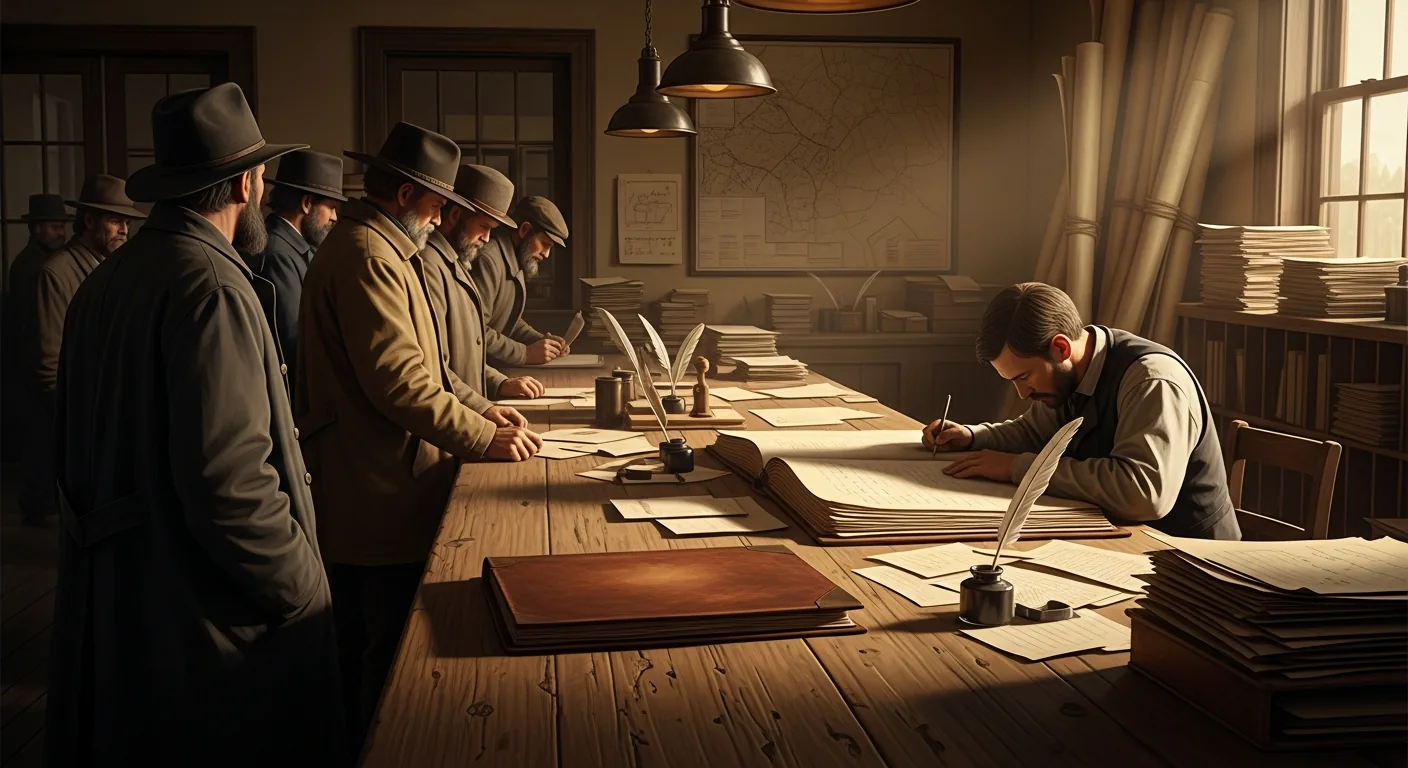
The Land Office. A surveyed grid, a counter, a clerk, a ledger, and a fee. This unromantic machinery is where a settler's months of plowing and building were finally converted into a patent — the document at the root of nearly every American land title.
Notice the shape of the process, because it recurs on every frontier and it is the template for our own. A claim moved through distinct, documented stages: a defined parcel described by survey; an entry filed in a public registry; a period of good-faith occupation and improvement; sworn proof, witnessed by neighbours, that the requirements were met; and, only then, the issuance of title. Possession opened the claim. Documentation closed it.
Part five
The wild west: how you actually got land.
Here is the part everyone pictures — the open plains, the racing wagons, the lonely cabin under an enormous sky. But the romance rode on top of a remarkably specific rulebook. The frontier was not lawless; it was governed by a stack of statutes that told an ordinary person, in plain terms, exactly how to convert sweat into ownership. Three of them did most of the work.
Squatters first: the Preemption Act of 1841
The frontier always ran ahead of the law. Settlers routinely pushed onto surveyed public land, built cabins, and started farming before the government put the land up for sale — they were, in the language of the day, squatters. For decades the official position was that they were trespassers. The Preemption Act of 1841 (September 4, 1841) blessed what was already happening: a qualifying settler who had moved onto public land, built a dwelling, and improved it earned a "right of preemption" — the right to buy up to 160 acres of the land they were already occupying, at the minimum government price of $1.25 an acre, before it went to public auction. In one stroke, the law recognized that the person who had actually settled and improved the ground had the first and best claim to own it. Preemption is the direct legal ancestor of the homestead.
The big one: the Homestead Act of 1862
Then came the law that defined the American frontier in the public imagination. The Homestead Act was signed by Abraham Lincoln on May 20, 1862, and took effect on January 1, 1863. Its offer was almost shockingly generous: up to 160 acres of surveyed public land, for free, to almost anyone willing to earn it.
But "free" came with a precise list of conditions — and those conditions are the whole point, because they define what the country considered a legitimate claim. To homestead, you had to:
Be a citizen, or have filed a declaration of intent to become one — a deliberately wide door, open to immigrants, women, and freed people after the Civil War.
Be the head of a household or at least 21 years old.
Have never borne arms against the United States — a Civil War–era loyalty test.
Live on the land and cultivate it for five continuous years, building a dwelling and farming the ground.
Finally, "prove up": appear at the land office with witnesses who would swear you had genuinely resided on and improved the claim, file the final proof, and pay a registration fee that came to roughly $18 in total.
Do all of that, and the United States issued you a patent. The land became yours not because you bought it but because you occupied and improved it in good faith, continuously, and then documented that you had. There was even a shortcut for the impatient, the commutation clause: after about six months of residence and improvement, a settler could skip the five-year wait and simply buy the claim outright at $1.25 an acre — $200 for a full 160-acre quarter-section.
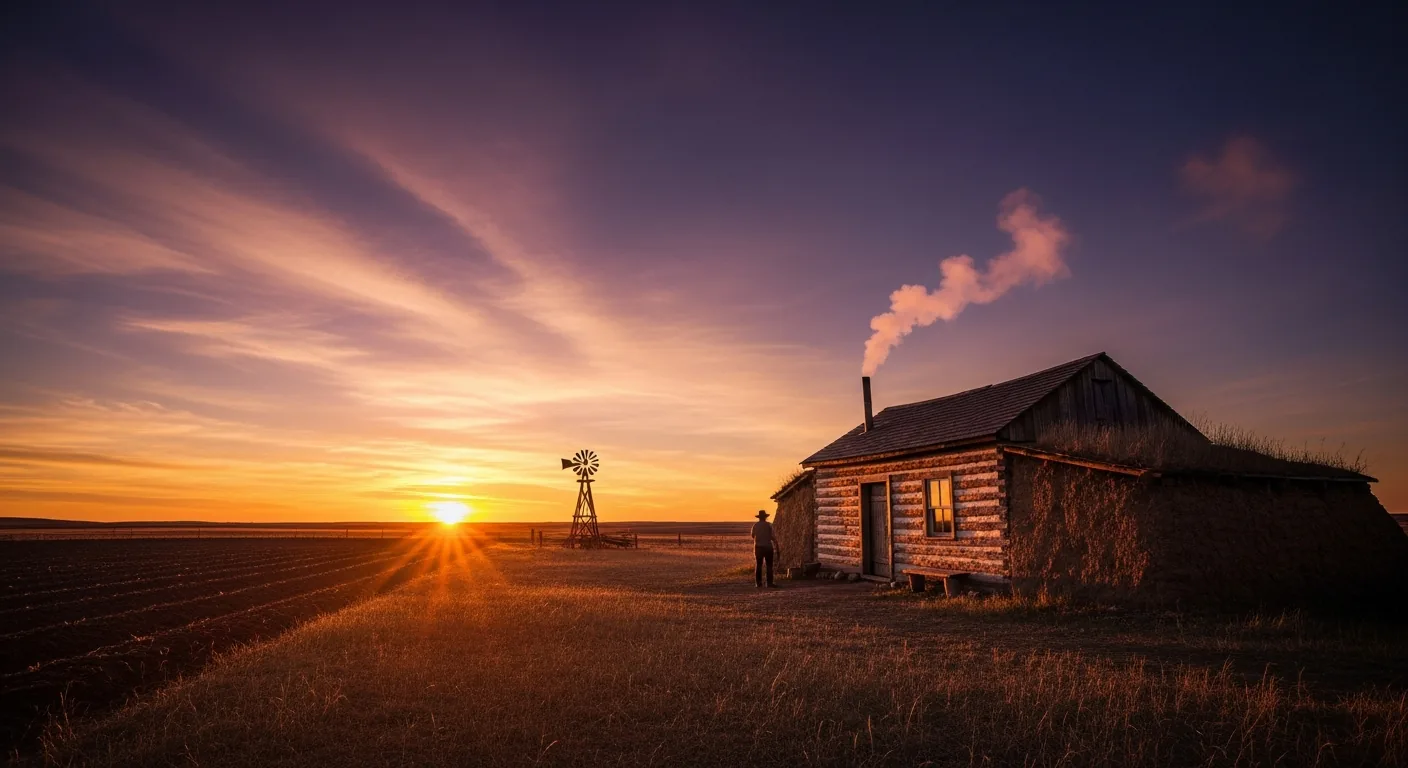
The proved-up claim. Five years of residence, a built dwelling, cultivated ground, and witnesses to swear it was true — that is what a homestead patent cost. The land was earned by living on it, not by paying for it.
The first person through the door is, by tradition, a Union Army scout named Daniel Freeman, who is said to have persuaded a clerk to open the land office in Beatrice, Nebraska just after midnight so he could file on January 1, 1863, the very first day the Act was in force. Whether he was provably the first in the entire country is one of those frontier "firsts" that is celebrated more than it is documented — but his homestead is preserved today as a national historical park, and his midnight filing is as good a symbol as any for the land hunger the Act unleashed. Over the following decades, homesteaders filed on hundreds of millions of acres. The law stayed on the books an astonishingly long time: homesteading in the lower 48 states ended only with the Federal Land Policy and Management Act of 1976, and Alaska kept the program alive until 1986, with the last homestead patent issued in 1988.
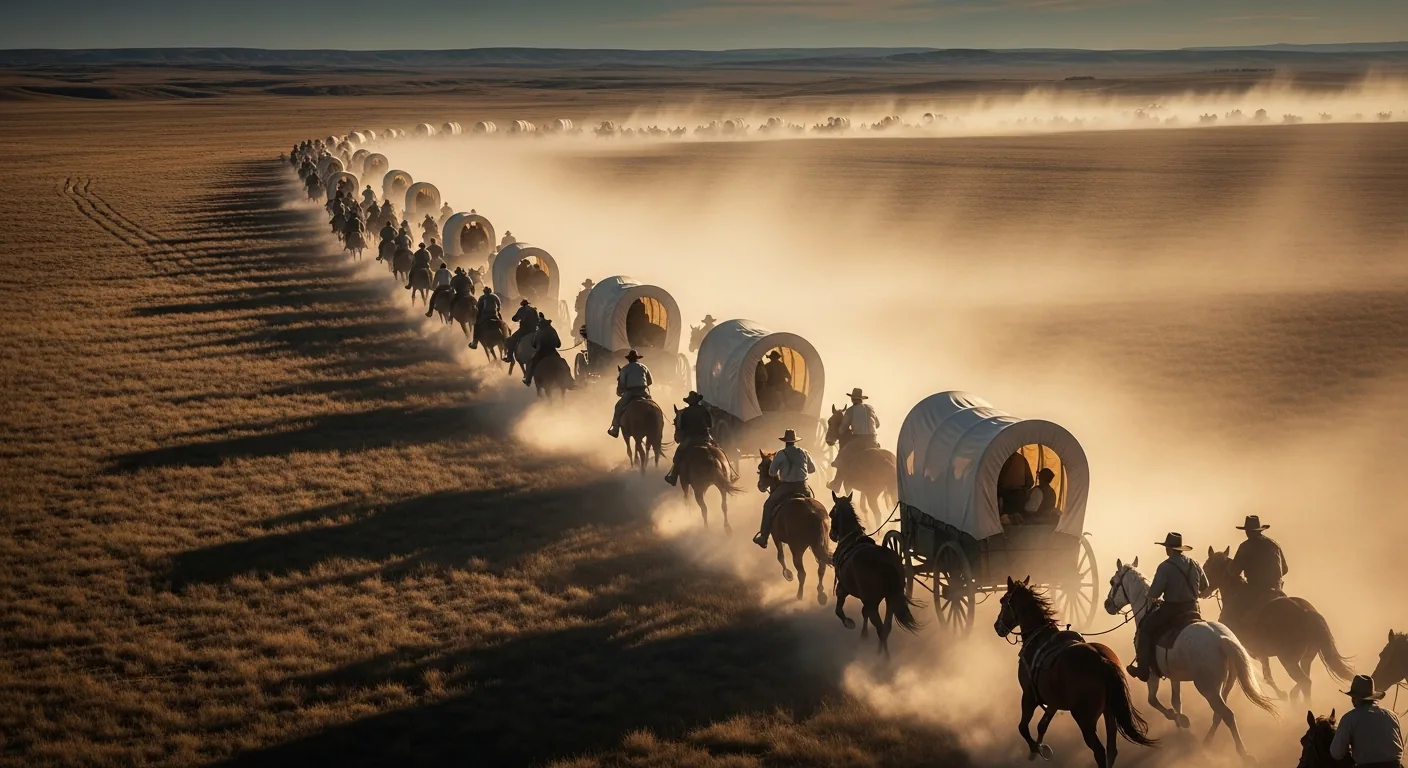
The race for ground. When public land opened, it could open all at once. The land rushes turned the orderly grid of survey-and-patent into a sprint — but even at a gallop, the prize was the same: get onto a parcel, hold it, improve it, and file.
Rock and metal: the General Mining Act of 1872
Farmland had the Homestead Act; minerals had their own, equally influential rulebook. The General Mining Act of 1872 (May 10, 1872) did something remarkable: instead of inventing a system, it largely wrote down the customs the miners had already invented themselves in the California and Nevada camps of the 1840s through 1860s. Under it, a prospector could stake a claim on federal mineral land entirely on their own initiative — no prior permission required — by doing three concrete things:
Discover a valuable mineral deposit actually present in the ground;
Mark the boundaries of the claim on the land itself, with stakes and monuments a person could see and walk;
Record a location notice — the locator's name, the date, and a description of the claim — in the local registry.
That trio — discovery, demarcation, recordation — is possession formalized into a procedure. And the mining country produced one of the most elegant ideas in all of property law: the doctrine of pedis possessio, literally "a foothold." (It lived in the common law that grew up around the statute, not in the words of the Act itself.) The doctrine held that a prospector who was actually, physically present on a claim and diligently working toward a discovery was protected against rivals trying to jump it — even before the discovery that would perfect the claim was made. In other words: showing up and genuinely working the ground earns you protection while you do the work. Your foothold is itself a right.
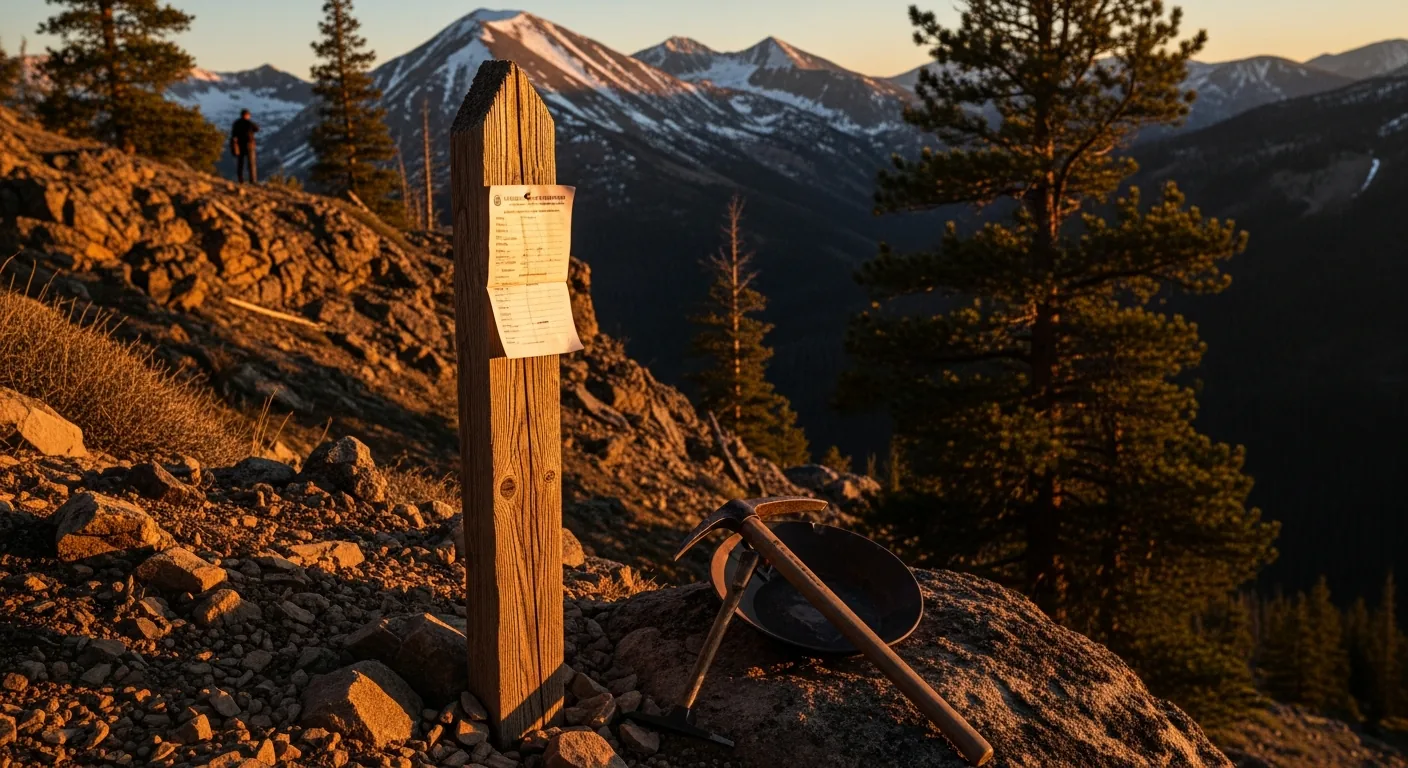
Staked and recorded. A stake, a notice, a name, a date. Under the 1872 mining law a prospector could turn a piece of public wilderness into a recognized claim by discovering, marking, and recording it — possession written down before any deed existed.
Before any of it: tomahawk, cabin, and corn
Underneath the statutes ran a layer of pure custom — the informal "rights" by which frontier people marked ground when no land office was within a hundred miles. A tomahawk right was claimed by deadening or blazing trees and carving your initials into the bark near a spring. A cabin right came from building a cabin. A corn right came from planting a crop. None of these had any standing in a courtroom — and yet they were bought, sold, traded, and widely honoured by neighbours, and they frequently became the factual basis for a later legal title under preemption. Where formal law was absent entirely, settlers organized claim clubs — local associations that registered members' claims and enforced them, sometimes at the end of a rope — under an ethic that came to be called "squatter sovereignty."
Strip away the picturesque vocabulary and the message is consistent across every one of these mechanisms: the act of occupying and improving land was the thing that created the claim. The statutes and the customs alike were just society's way of recognizing, recording, and ranking those acts of possession.
Every rule of the frontier — homestead, preemption, mining claim, tomahawk right — was the same idea in different clothing: be there, work it, document it, and the law will come to recognize what you have already built.
Part six
Florida: a peninsula claimed by occupation.
Florida deserves its own chapter, because it compresses almost every theme in this story into a single hot, contested peninsula — Spanish grants, a change of flag, a violent frontier, and a settlement law unusually frank about what it wanted.
Florida came to the United States from Spain. The Adams–Onís Treaty — signed on February 22, 1819, but not actually effective until ratifications were exchanged on February 22, 1821 (mind that two-year gap; it matters for dating any Florida title) — transferred the territory and, as in California a generation later, obliged the United States to honour valid Spanish land grants. Once again, "valid" meant "provable," and Florida's Spanish grant holders spent decades in adjudication establishing which of their titles the new government would recognize.
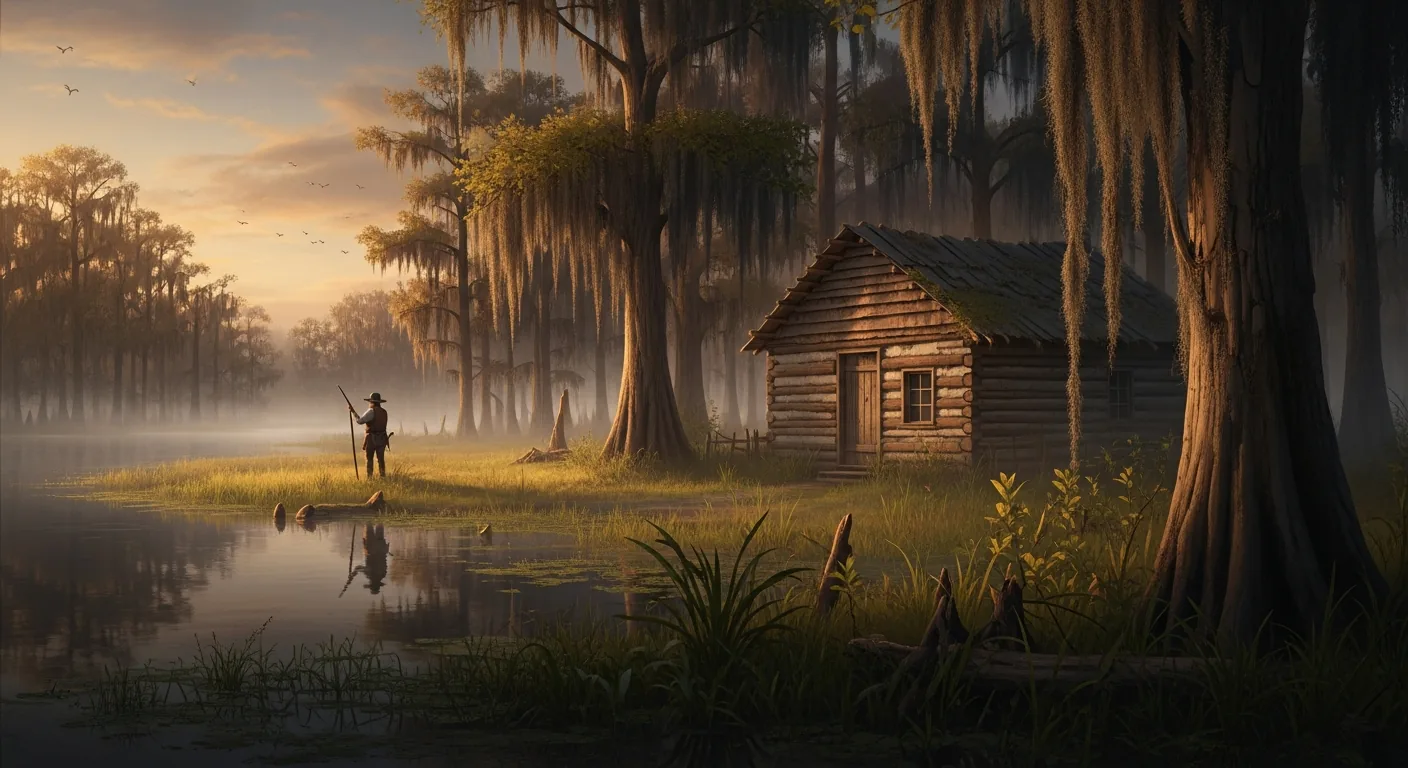
The armed homestead. Florida's interior was opened by a law that paid settlers in land to live on a dangerous frontier and defend it. To earn 160 acres you had to occupy, build, cultivate — and be willing to carry a rifle while you did.
But the most revealing Florida law is the Armed Occupation Act of 1842 (August 4, 1842). The United States was fighting a long, grinding war with the Seminoles, and it wanted the interior of the peninsula settled by people who would hold it. So it made a deal that reads, today, like the homestead model with the subtext made text. A head of family or single man able to bear arms could claim 160 acres in the contested interior of East and South Florida, provided he:
obtained a permit for the specific parcel;
resided on it for five years;
built a house and cleared and cultivated at least five acres within the first year; and
located his claim at least two miles from any garrisoned military post — because the entire point was to put armed settlers between the forts, where the government could not otherwise hold ground.
The Act opened roughly 200,000 acres and was, in effect, a frontier defense policy paid for in land. It states with unusual honesty what the gentler homestead language usually left implicit: that the government was trading title for the dangerous, continuous, physical occupation of contested ground. Occupy, build, cultivate, endure — and the land is yours.
Florida adds one more wrinkle worth knowing, because it shaped the state's geography for a century: the Swamp Land Act of 1850, which transferred millions of acres of federal "swamp and overflowed" land to the states on the theory that the states would drain and reclaim them. Florida received on the order of 20 million acres — much of the Everglades watershed — funneled through a state Internal Improvement Fund that became the legal engine of generations of drainage, development, and dispute. It is a reminder that land law does not only decide who owns the ground; it quietly decides what becomes of it.
Part seven
Another frontier, another flag: the Amazon.
Now cross a hemisphere, because the American story is not the only one, and the contrast is illuminating. Brazil is still actively living the frontier that the United States closed a century ago. On the vast edges of the Amazon, the questions colonial Virginia and homestead Nebraska answered in the 1800s are being answered right now — and the legal vocabulary, while different, rhymes with everything above.
Brazil's colonial land system ran on royal grants called sesmarias, much like the Crown grants of the English coast. That system was swept away by the Lei de Terras — the Land Law, No. 601 of September 18, 1850 (regulated and effective from 1854). The Land Law did two things that still define Brazilian property: it declared that, from then on, the only legal way to acquire public land was to buy it (ending acquisition by mere occupation), and it defined the great category of unclaimed public land that haunts every Brazilian frontier dispute — the terras devolutas, the "vacant" or unappropriated public lands that belong to the state until someone lawfully acquires them.
And yet possession refused to die as a route to ownership, because on a frontier it always reasserts itself. Brazilian law retained — and still has — a powerful doctrine of acquisitive prescription called usucapião, the close cousin of American adverse possession. Occupy land in the right way for the right length of time and you can acquire title to it. The timeframes map almost eerily onto the homestead logic:
Special rural usucapião (the "pro labore" or constitutional kind): just five years of possession of a rural parcel of up to 50 hectares, made productive by your own work, where you own no other property. Five years and your labor — the homestead bargain in Portuguese.
Ordinary usucapião: ten years, with a colorable title and good faith.
Extraordinary usucapião: fifteen years with no title or good faith required at all — reduced to ten if you actually live on the land or have made it productive.
Most striking for our purposes, Brazil modernized the procedure in a way that points straight at what a registry like ours does. Since the 2015 Civil Procedure Code (in force from March 2016), Brazil allows usucapião extrajudicial — adverse possession perfected without a court, processed directly at the real-estate registry by a notary, on the strength of a documented file: a notarial attestation of the facts (the ata notarial), a survey, and supporting proof. Possession, properly documented and published through the registry, can ripen into title without a judge ever being involved. The paperwork is the path.
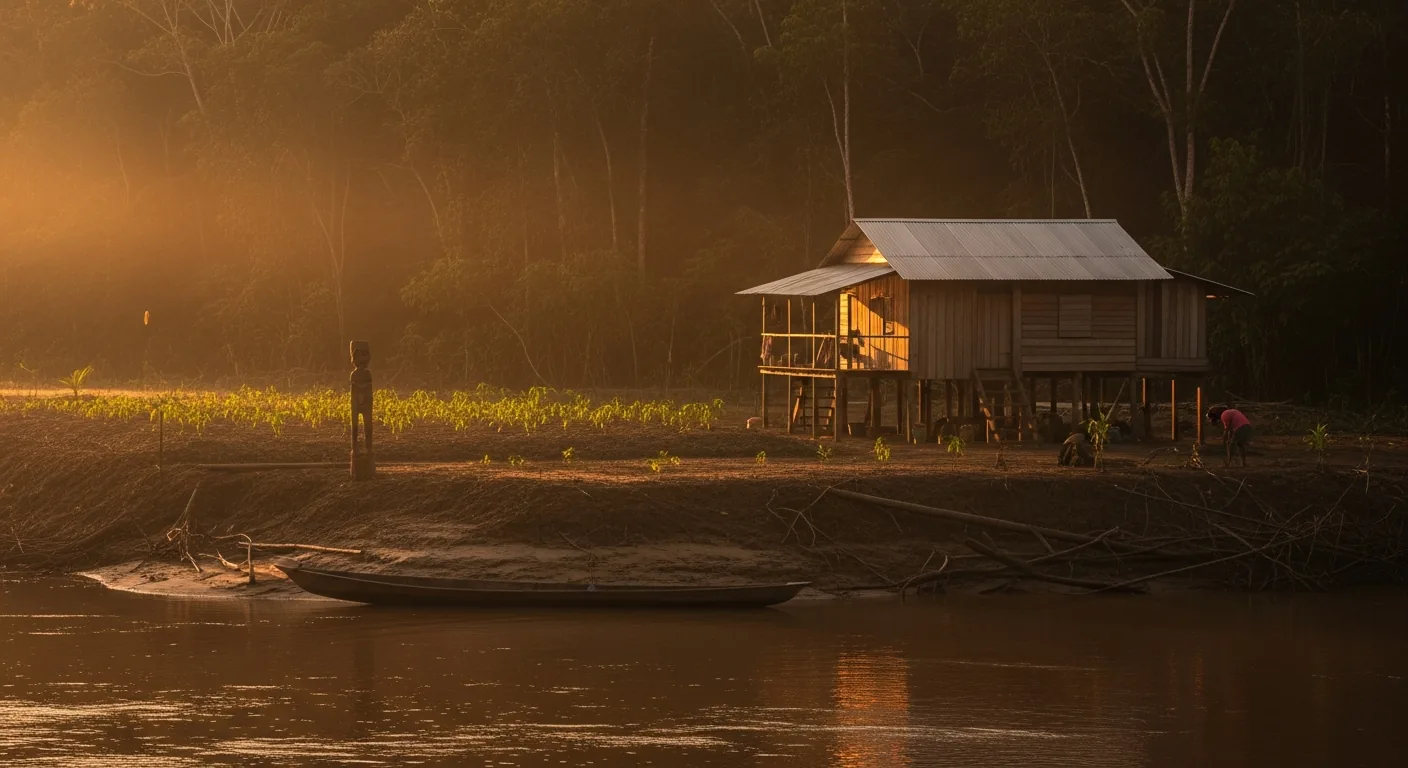
The living frontier. On the Amazon's edge, land is still claimed the old way — by clearing, building, and occupying, then fighting to have that possession recognized. Brazil's land agencies regularize titles based on proof of direct, peaceful, productive occupation, much as the U.S. Land Office once did.
The frontier's dark side has a name here too. Grilagem is the Brazilian word for large-scale land fraud — the forging of titles to seize public or others' land. The term is wonderfully, grimly literal: grilo means cricket, and the classic trick was to lock forged deeds in a box full of crickets, whose droppings and gnawing would age the fresh paper until it looked like a yellowed, antique title. A grileiro is a land-grabber. The fraud has since gone digital, migrating into the abuse of electronic rural-registry systems — but the lesson it teaches is exactly the one this registry is built around: a title is only worth the integrity of the record behind it. A forged claim with no genuine possession is a cricket-aged lie. A genuine possession, openly and honestly documented, is the real thing the forgers are trying to imitate.
Finally, Brazil does at national scale what the homestead and preemption acts did: it regularizes frontier possession into title. The Terra Legal program, created by Law No. 11.952 of June 25, 2009 for the Legal Amazon and administered through the land agency INCRA, grants title to occupants of federal land based on proof of direct, peaceful, and productive occupation — cultivation and improvements, the benfeitorias — predating a legal cutoff, for areas up to 2,500 hectares (with a faster track for small family farms). It has issued tens of thousands of titles, and like every frontier regularization before it, it has been praised for bringing order and criticized for occasionally rewarding the grileiro. That tension — between honoring genuine possession and being gamed by false claims — is the eternal problem of frontier land. The only known defense is rigor in the record.
Part eight
The thread running through all of it.
Step back from four centuries and two hemispheres and the pattern is impossible to miss. The flags differ. The forms differ. The acreages, the timeframes, the names of the offices differ. But underneath, every one of these systems answers the frontier's only real question in the same way.
1618Virginia
Headrights. Put a person on the ground, get 50 acres. Title rewards the act of populating and holding land.
1841U.S.
Preemption. The squatter who settled and improved public land gets the first right to buy it. Possession beats the auction.
1842Florida
Armed Occupation. 160 acres for occupying, building on, and defending contested ground for five years.
1851California
Land Commission. Even pre-existing grants survive only if the holder can prove and defend them on the record.
1862U.S.
Homestead. Live on it, cultivate it five years, prove it up with witnesses — and the patent is yours.
1872U.S.
Mining law & pedis possessio. Discover, mark, record — and your very foothold is protected while you work.
2009Brazil
Terra Legal. Title granted on proof of direct, peaceful, productive occupation of the Amazon frontier.
2016Brazil
Usucapião extrajudicial. Possession, documented at the registry, ripens into title with no court at all.
Four threads tie the whole tapestry together:
Possession comes first. In every system, the seed of title is the physical, good-faith act of occupying and using the land — not the paper. The paper recognizes the possession; it does not invent it.
Improvement proves intent. Clearing, building, planting, residing — "doing the work" is how a claimant demonstrates the difference between a serious settler and a speculator with a map. Every law in this story rewards the worker over the absentee.
Documentation converts possession into a right. The survey, the entry, the witnesses, the recorded notice, the notarial file — the act of documenting possession in a public, contestable record is what allows the law to recognize it. Possession that is never documented stays a fact; documented possession becomes a claim.
Recognition comes last, and it follows the record. Title is granted by whatever authority eventually holds jurisdiction — a Crown, a land office, a notary, a court. And when it comes, it goes to the claimant with the strongest, earliest, best-documented good-faith possession. The Californios lost land not because their claims were false but because they could not defend the record. The grileiro wins only when the record is too weak to expose him.
That is the deep structure of how frontier land becomes owned land: occupy in good faith, improve, document continuously, publish openly, and stand ready to defend the record until an authority with jurisdiction recognizes it. It has been true on two coasts, in a swamp, and in a rainforest. The only question left is whether it can be true on a place with no atmosphere and no flag.
Part nine
What this means for the Moon and Mars.
Here is where we have to be the most honest, because honesty is the entire reason this registry exists. Everything above describes systems in which an authority with jurisdiction eventually recognized documented possession. On the Moon and Mars, that authority does not exist today. The 1967 Outer Space Treaty (Article II) bars any nation from appropriating celestial bodies, and there is no sovereign, no court, and no land registry anywhere with the jurisdiction to grant or enforce private title beyond Earth. No one can sell you legal ownership of land on Mars, and we never will. Anyone who tells you otherwise — anyone selling you a "deed" to a crater for twenty-five dollars — is selling a novelty at best and a lie at worst.
So what is left? Read this whole history again and the answer is obvious, because it is the part of every system that came before the recognition: the documented, good-faith, continuously-maintained act of possession. On every frontier, that came first and existed for years or decades before any authority arrived to bless it. The homesteader's claim was real the day he filed it, not the day his patent printed five years later. The usucapião possessor's file is real long before the registry stamps it. The Californio's title existed under Spanish law before any American board confirmed it. Documented possession is the thing that waits for recognition — and the better documented it is, the better it tends to fare when recognition finally comes.
There is even a way in which Mars is a cleaner canvas than any earthly frontier. Every land system in this article was built, in part, atop the dispossession of people who were already there. Mars has no prior inhabitants. A good-faith claim on Martian ground displaces no one — which means, for the first time in the history of frontier land, the moral problem at the center of this entire story simply does not arise.
This is exactly, and only, what Spaceclaims builds. Not a title. Not an investment. Not a promise that any government will ever honor your parcel. What we build is the strongest documented good-faith forward claim a person can make on off-world land today — assembled deliberately from the very mechanisms this history reveals as the universal seeds of title:
A defined, surveyed parcel on real, mapped terrain — your tract described with the precision the Public Land Survey brought to the American grid, not a random pixel.
A timestamped entry establishing the date and priority of your claim — because on every frontier, who was documented first mattered.
A public, contestable record with an opposition period — the registry equivalent of the land office's witnesses and the notary's published file, so your claim is tested in the open rather than asserted in the dark.
A statement of good-faith intent and improvement — your homestead purpose, your plan for the ground — the modern descendant of "prove up," tomahawk-and-cabin, and benfeitorias.
Continuous maintenance of the file — because every system in this story rewarded continuity of possession and punished the claim that lapsed. A maintained claim is a living one.
We assemble these into a single, notarization-supported, publicly-published, continuously-maintained claim file — nineteen instruments modeled directly on the homestead file, the mining-claim location, and the Brazilian usucapião dossier. We do it transparently, we tell you exactly what it is and is not, and we never once pretend the paper is a title. That honesty is not a weakness in the product. After four hundred years of frontier history, it is the product: the genuine, documented possession that the forgers spend their lives trying to counterfeit.
The frontier has always belonged, in the end, to the people who showed up, did the work, and kept the best records. Mars is the next frontier. The rules of the last one are still good.
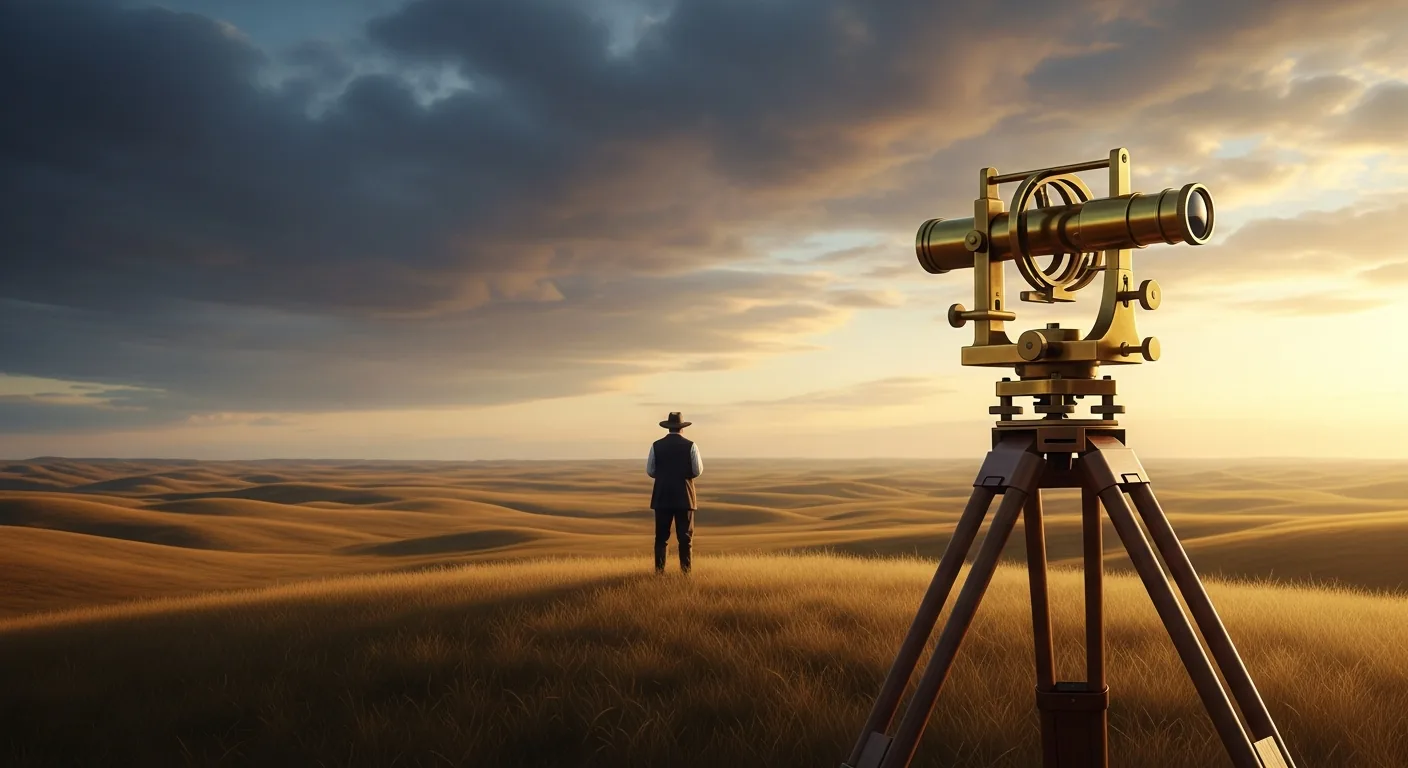
The same act, on a new world. A surveyor, an instrument, a marker, a record. The oldest human gesture toward owning ground — measuring it, occupying it, documenting it — repeated on the ground that comes next.
Dates, acreages and figures in this article are drawn from public legal and historical sources (the National Archives, the Bureau of Land Management's General Land Office records, state archives, and standard legal histories) and are summarized for a general reader; some "firsts" — notably the first U.S. homesteader — are traditional honors more than provable facts, and we have flagged them as such. Nothing in this article is legal advice, and nothing in it represents that land on the Moon, Mars, or any celestial body can presently be owned, sold, or legally titled. Spaceclaims conveys no legal title and guarantees no recognition of any claim. See our full legal & disclaimer page.
Important legal disclaimer
No conveyance of legal title. The 1967 Outer Space Treaty (Art. II) bars national appropriation of celestial bodies, and no sovereign, court, or land registry currently has jurisdiction to grant or enforce private title to land on the Moon, Mars, or any celestial body. Spaceclaims does not and cannot convey legal ownership or any presently-enforceable property right.
What you purchase. A claim-documentation and registry service — the preparation, notarization support, public publication, opposition-period adjudication, and continuous-possession recordkeeping of a good-faith homestead claim — together with a collectible certificate. It is a record of your claim and intent, not a title.
Not an investment; not a security. Your payment is not an investment of money in a common enterprise and carries no expectation of profit from our efforts. We make no representation as to resale value, appreciation, or return. The claim is not offered as a security and is not registered with the SEC, any state regulator, the Brazilian CVM, or any other authority.
No guarantee of recognition; no sovereignty; not legal advice. We model the process on frameworks in which documented good-faith possession was sometimes later recognized, but we do not guarantee any authority will ever recognize your claim. No Spaceclaims claim asserts national sovereignty. Nothing here is legal, tax, or financial advice.
We use cookies and analytics to understand how visitors use this site. You can accept or decline non-essential cookies. See our Privacy Policy.