The first factory on Mars — how drones and rovers will be built there.
Every machine on Mars right now was made on Earth and shipped 100 million miles. That cannot last. This is the engineering of what happens next: what the Martian ground contains, which components can be fabricated first, what the first locally-assembled aircraft looks like, and the 50-year road to a planet that builds its own machines.
By the Spaceclaims Registry~4,000 words · 18 min readJune 2026
🏭
This is a technical and scientific explainer drawn from published ISRU research, NASA mission records, and planetary materials science. It explains the real engineering of Martian manufacturing. No legal title is conveyed on the Moon or Mars today.
Every machine on Mars right now — every wheel, every rotor, every circuit board, every bolt — began its life in a factory somewhere on Earth. It was shipped to a launch site, loaded onto a rocket, and flung into space on a trajectory that took between six and nine months to complete. Then it survived entry, descent, and landing on a planet that tries hard to kill everything that arrives.
That is the status quo of Martian hardware. For a single rover, a single helicopter, it works. For a civilization, it is a terminal constraint.
The arithmetic of deep-space logistics is pitiless. Even with the most optimistic projections for reusable heavy-lift rockets, sending hardware to Mars costs enormously more than sending it to Earth orbit — the transfer burn, the six-month cruise, the deep-space thermal management, the landing system all compound the cost and risk. And even setting cost aside, there is the launch window. Mars and Earth align for an economical transfer roughly every 26 months. If your drill breaks on Mars, you wait two years for the next parts shipment. If your solar panel cracks, you wait. If the bearing in your rover's wheel wears out, you wait. An operation that depends on a supply chain with a 26-month reorder cycle and a six-month delivery time is not an operation — it is a maintenance problem waiting to end everything.
The launch window is the silent tyrant of Mars logistics. Two years between resupply opportunities means every broken tool, worn wheel, or failed motor sits idle for potentially longer than some missions last. The only durable answer is to stop shipping finished machines and start making them there.
The answer — which aerospace engineers and planetary scientists have discussed for decades and are now actively designing into real mission architectures — is in-situ manufacturing: making things on Mars, from what Mars has, because Mars has a great deal to work with.
This is that story. Not science fiction, but an engineering roadmap: what the first Martian factory actually produces, in roughly what order, using chemistry and processes that are already proven at laboratory scale.
Part two
What Mars has to work with.
Before you can build a factory you need raw materials, and Mars has plenty. The Martian surface has been analysed in extraordinary detail by orbiters, landers, and rovers over fifty years. Here is the balance sheet.
17–20%
Iron oxide
The planet is red because it is rusted. Iron oxide is the dominant chromophore in Martian soil — and under the right electrochemical conditions it becomes structural iron and steel.
~45%
Silicon dioxide
The single largest component of Martian regolith. Purified, it becomes glass and solar-cell feedstock. At chip-grade purity it becomes semiconductors — though that is a far harder industrial challenge.
~7%
Aluminum oxide
Less abundant than on Earth but present and extractable. Aluminum is light, strong, and conducts electricity — a natural candidate for drone airframes, rover chassis panels, and electrical wiring.
Widespread
Volcanic basalt
Widespread volcanic rock that can be melted and drawn into basalt fiber — a composite reinforcement stronger than fiberglass, usable in vehicle panels, structural tubing, and rotor blades.
96%
CO₂ atmosphere → Oxygen
The Martian atmosphere is 96% carbon dioxide. Electrolyzing CO₂ produces oxygen — a rocket propellant, a breathing gas, and a chemical reagent needed in half the industrial processes the colony will run. Perseverance's MOXIE experiment proved it works on Mars in 2021.
What Mars notably lacks — or has only in inconveniently dispersed concentrations: nickel (stainless steel), lithium (high-density batteries), rare earth elements (electric motors and sensors), and the industrial copper concentrations that make wiring easy on Earth. These are not absent; they are present in low concentrations requiring more advanced extraction than a first-generation colony will likely attempt.
The picture: Mars can readily supply structural materials — iron, aluminum, silicon, basalt — and will struggle to produce precision electronics, high-performance batteries, and specialty alloys for some time. That constraint shapes everything about how Mars builds its first machines.
Part three
The first generation: import and assemble.
The earliest phase of Martian manufacturing will not look like manufacturing at all by Earth standards. It will look like assembly.
In the first decade after humans establish a permanent presence, the likeliest model is this: precision components — microprocessors, sensors, electric motors, bearings, specialty cables, battery cells — arrive from Earth; structural components are made locally and assembled into finished machines on the surface.
This matters even before true in-situ manufacturing begins. Shipping a machined aluminum frame from Earth costs far less, in launch mass, than shipping the assembled rover it would be part of. If a Mars workshop can produce a rover chassis from local aluminum and bolt imported electronics into it, each resupply mission from Earth delivers far more capability for the same mass budget. The ratio of "functional machine" to "launch mass" improves dramatically before a single Martian-mined atom goes into the product.
Ship the intelligence, build the body there. Every ton of local structure is a ton of imported electronics that fits in the same rocket.
An early Martian manufacturing operation of this type might look like: a pressurized workshop where robotic arms cut and weld aluminum plate into rover body panels and chassis sections; a 3D printer depositing sintered regolith into structural brackets; a human technician or remotely-supervised robot assembling the stack with fasteners and adhesives — many imported — and then installing an imported motor controller, sensor suite, and battery pack.
The final machine is "Made on Mars" in roughly the same sense that a device assembled from globally-sourced parts is "Made" wherever it was put together. The assembly happens there; the hardest components come from elsewhere. That is not a criticism — it is an accurate picture of how industrialization always starts. The American frontier imported iron rails from Britain before it made its own. Mars will import microelectronics from Earth before it fabs its own. Local assembly, even of imported parts, is the first foothold of a manufacturing chain.
Part four
What 3D printing with Martian regolith can really do.
The most accessible manufacturing process for early Mars is regolith 3D printing — using the ground itself as feedstock for additive manufacturing. NASA, ESA, and multiple university research groups have demonstrated this at varying scales, and the results are more capable than they might sound.
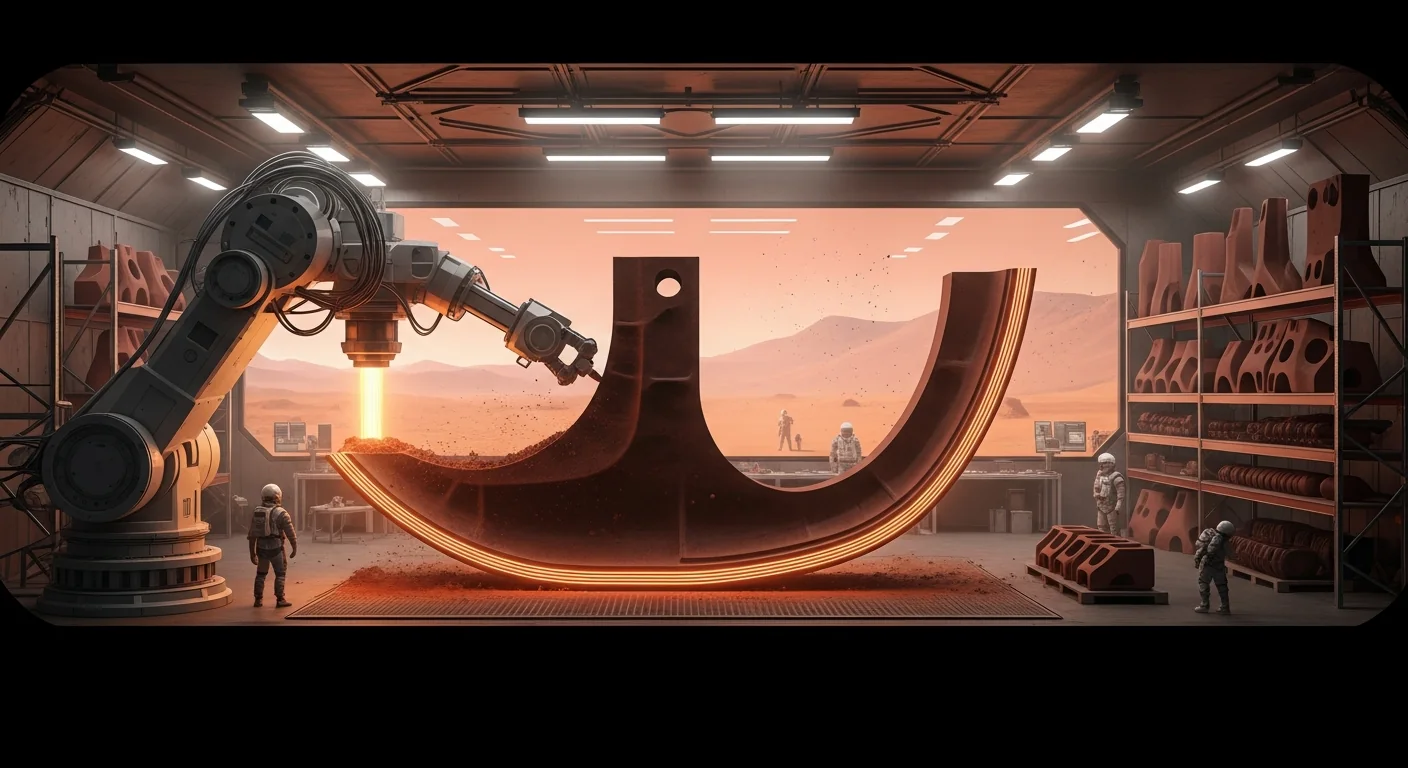
Layer by layer, from the ground itself. A regolith 3D printer deposits sintered Martian soil in precise layers, building up a structural bracket. The dark rust-red finished parts stacked behind it will become housings, mounts, and base plates — structural members that never needed to leave Earth's orbit.
The basic process: fine Martian regolith is mixed with a small amount of binding agent (which may itself be chemically synthesized on Mars), heated or cured, and deposited layer by layer to build up a structural form. The resulting material is a ceramic-like composite with compressive strength comparable to concrete and reasonable structural rigidity. It cannot be machined like metal — it is brittle under tension — but it excels as a compression-loaded structural element.
In practice, housings, brackets, base plates, and mounting structures for machinery can all be printed from regolith. A rover chassis frame is not a precision part — it needs to be stiff, have mounting points, and survive vibration and temperature cycles. All of these are achievable in a 3D-printed regolith composite, meaning a significant portion of a rover's structural mass can be produced without any smelting or metal refining.
More importantly, regolith printing is being studied for large-scale habitat and infrastructure construction — the Mars equivalent of pouring a concrete foundation. A facility that can print habitats can equally print a factory floor, a tool enclosure, or the landing pad for a drone. The same machine that builds the workshop later builds the components that go inside it.
The limitation: printed regolith, while structurally useful, is not a precision material. You can build a box from it; you cannot print a motor shaft or a bearing race. The precision components that move, rotate, and conduct remain the domain of metal machining — which brings us to the harder but more transformative process.
Part five
Making metal from rust.
The most consequential near-term manufacturing process for Mars is molten oxide electrolysis (MOE) — a technique that uses electrical current to split iron oxide directly into liquid iron metal and oxygen gas, with Martian soil as the sole starting material.
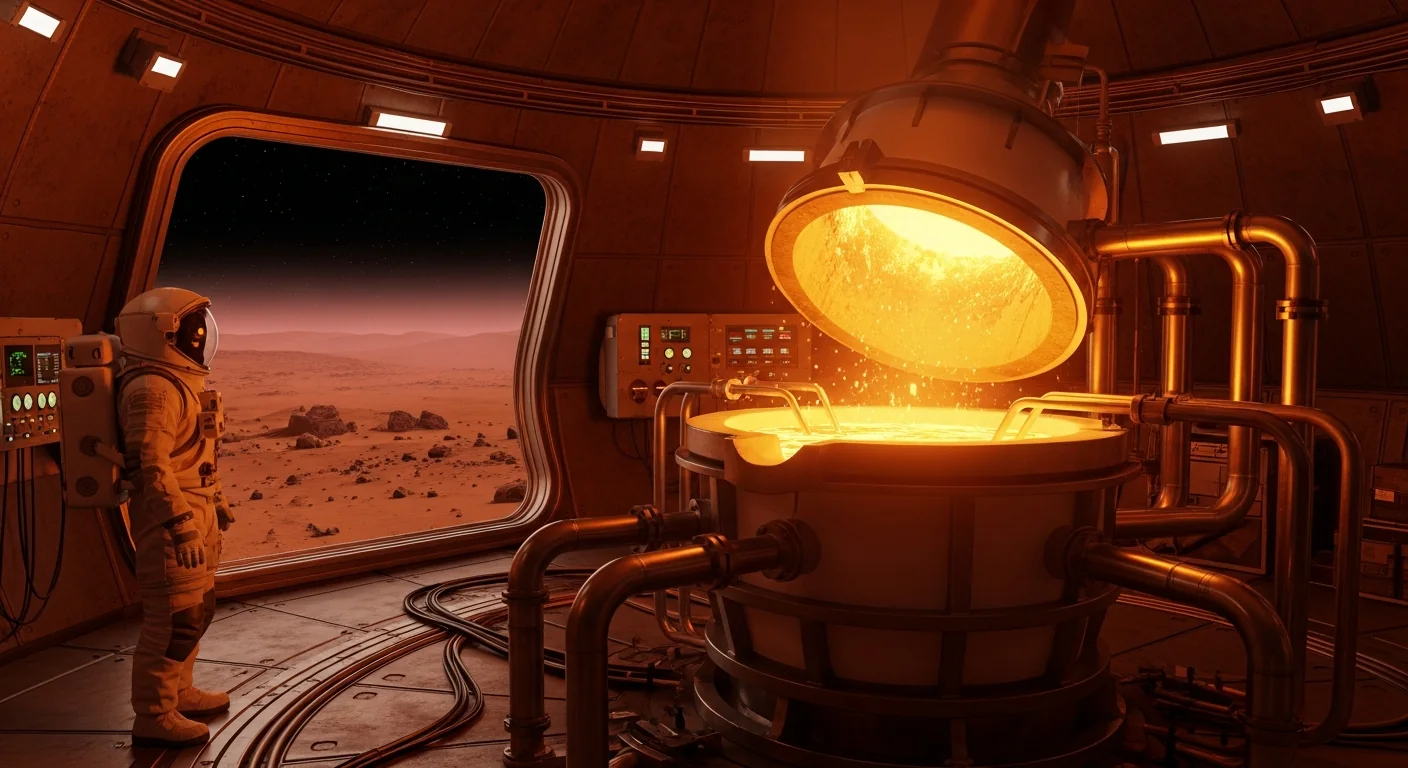
Metal from rust, oxygen from the same act. Molten oxide electrolysis turns Martian regolith — iron oxide, aluminum oxide, silicon oxide — into useful metals and breathable oxygen simultaneously, using only electrical power and the ground beneath the facility.
The concept was first proposed for space applications by MIT researchers around 2012 and has been developed substantially since. A small "electrolyzer" cell is filled with molten Martian soil (which melts at around 1,500 °C) and a current is passed through it. Iron migrates to the cathode and pools as liquid metal; oxygen bubbles off the anode. Both products are immediately useful: the iron is structural metal, the oxygen is propellant and breathing gas.
Crucially, the waste stream from molten oxide electrolysis is almost zero. You put in regolith and electricity; you get out iron and oxygen. The electricity comes from solar or nuclear power; the regolith is everywhere. There is no feedstock supply chain to worry about, no consumable reagent to ship from Earth.
The iron produced by this first-generation process is not chemically pure — it is closer to a cast iron alloy than structural steel, containing residue from the soil matrix. With additional processing and carbon (which the Martian atmosphere provides in abundance as CO₂), it can be worked into usable steel. What you get first is a rough but functional structural metal — good for beams, brackets, rough castings, and the molds and tooling that make subsequent machining possible.
Aluminum extraction is thermodynamically harder and requires different electrode chemistry, but it is on the roadmap. Aluminum matters enormously because it is lightweight — essential for aircraft — and it conducts electricity, allowing it to substitute for copper wiring in some applications.
The image to hold in mind: by the late 2040s, a Martian facility likely has a small smelting hall powered by a nuclear reactor, producing rough iron ingots and aluminum plate from raw soil. Slow, energy-intensive, and producing industrial-grade rather than precision material — but it is Martian metal, and that changes everything about what the workshop next door can build.
Part six
Silicon, glass, and the long road to local electronics.
Silicon is the element Mars offers in extraordinary abundance, and what a settlement does with it spans a wide range of ambition and timeline.
Glass is the simplest application: melting silica-rich regolith produces crude glass suitable for windows, lenses, and structural glazing in greenhouses and habitats. This capability likely arrives in the first decade of a permanent settlement, and the same furnaces that make glass can make the transparent dome panels that let a manufacturing facility have natural lighting.
Solar cells are the higher and more transformative prize. The Martian surface receives roughly 43 percent of Earth's solar irradiance — less than ideal, but with locally manufactured solar panels, that becomes essentially free electricity, no supply chain required. Manufacturing a photovoltaic cell requires purifying silicon to a very high degree, depositing thin semiconductor layers, and adding metal contacts. None of these steps are impossible on Mars; all of them are industrially demanding. Research programs are actively working on thin-film solar manufacturing methods adaptable to in-situ production using Martian silicon, aluminum, and basic chemical feedstocks. Credible estimates put the first Martian-manufactured solar cells in the 2040s window.
A rough manufacturing readiness ladder. Timelines depend heavily on mission cadence and investment, but the ordering is driven by physical chemistry: structural materials before precision materials before semiconductor fabrication.
Microelectronics — chips, processors, sensors — are the hardest problem on this ladder. Semiconductor fabrication requires extraordinary chemical purity, ultra-clean environments, and exotic process chemicals, much of which do not exist on Mars in any useful form. Realistically, for several decades at minimum, the circuit boards and processors in Martian drones and rovers will still come from Earth. Their mass is small; their performance is extraordinary; and replicating a chip fab on Mars is a civilization-scale project, not a frontier-colony project.
The practical implication: Martian manufacturing builds the physical structure of machines from local materials; Earth supplies the intelligence. That division of labor shapes the entire design of first-generation locally-built vehicles.
Part seven
The first locally-manufactured drone.
Given everything above, what does the first drone built on Mars actually look like — and how much of it comes from local materials?
The key insight is that the physical structure of a drone — frame, arms, motor mounts, body panels — accounts for roughly 40 to 60 percent of total mass. Everything structural is a candidate for local production. Everything electronic is not.
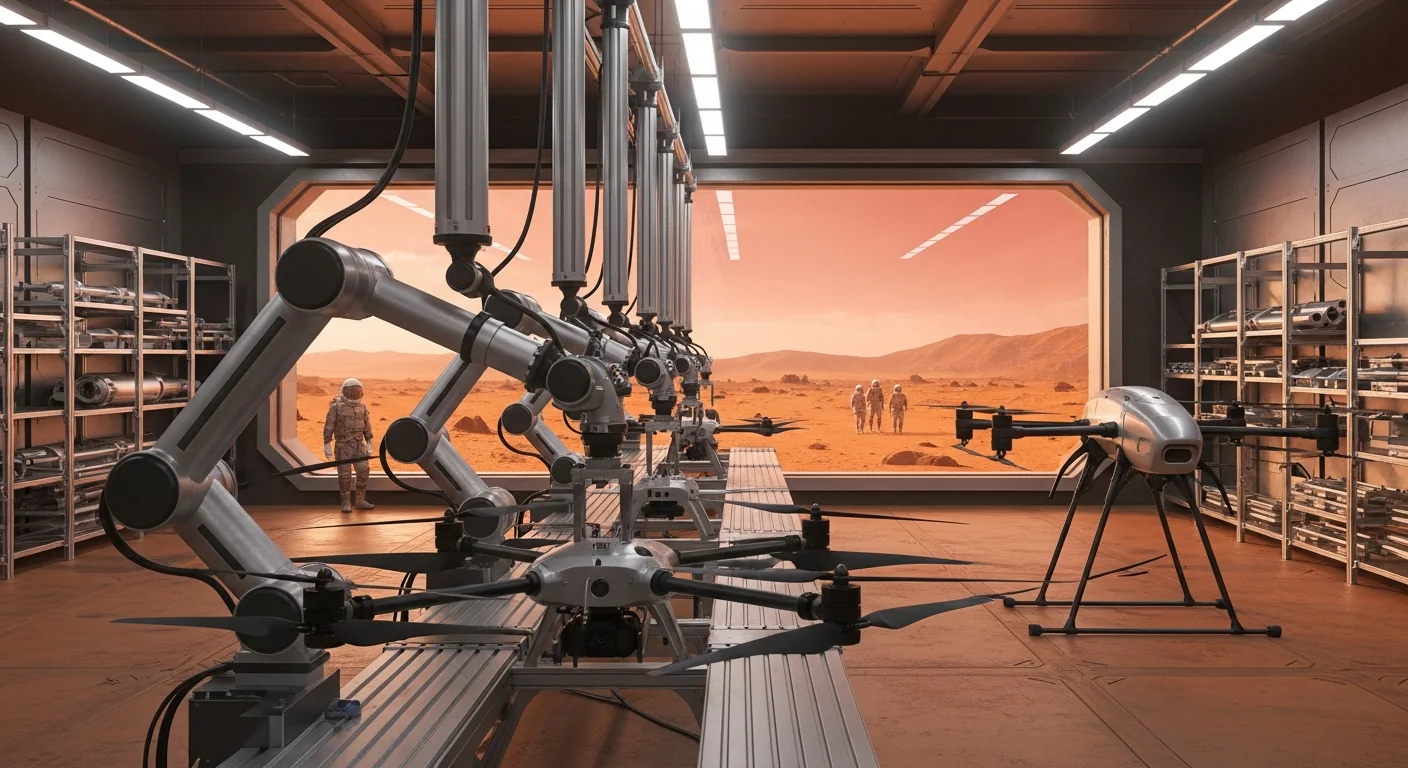
Local structure, imported intelligence. Robotic arms assemble a Mars-manufactured drone airframe. The aluminum body and rotor arms come from Martian smelting; the motors, sensors, and flight controller arrive from Earth. Each resupply mission now delivers capability per kilogram that a complete pre-built drone never could.
Locally manufactured on Mars (2040s)
Still imported from Earth
Frame, arms, and motor mounts — machined aluminum plate
Electric motors (require rare-earth magnets)
Rotor blades — basalt fiber composite or machined aluminum
Motor controllers and ESCs (precision electronics)
Body panels and housings — printed regolith or aluminum sheet
Flight controller, processor, IMU
Structural fasteners — machined local iron or aluminum
Cameras and imaging sensors
Solar panel (late 2040s, if thin-film silicon online)
Battery cells (lithium rare on Mars)
Aluminum wiring for lower-frequency runs
Precision bearings and specialty seals
The first locally assembled Mars drone is a hybrid: local structure carrying imported intelligence and power. It is a significant milestone — the frame, arms, and rotor blades accounting for most of the vehicle's volume and roughly half its mass are no longer shipped across interplanetary space. Each Earth resupply mission now delivers motors and sensors rather than complete aircraft, multiplying the number of vehicles that can be fielded per ton of cargo.
There is a further advantage that matters specifically on Mars: design iteration. If a frame cracks or a rotor arm is the wrong length for a specific survey mission, a locally manufactured replacement can be fabbed in hours, not waited for across the 26-month launch window. The Martian colony gains the ability to adapt its equipment to the ground it is actually operating on.
Part eight
Building rovers that never left Mars.
A rover is a heavier, more complex machine than a drone, but the manufacturing calculus is similar — and in some ways more favorable, because a rover's mass budget allows for heavier, simpler local materials. The largest and heaviest parts of a rover are structural, and structural parts are exactly what Mars can make first.
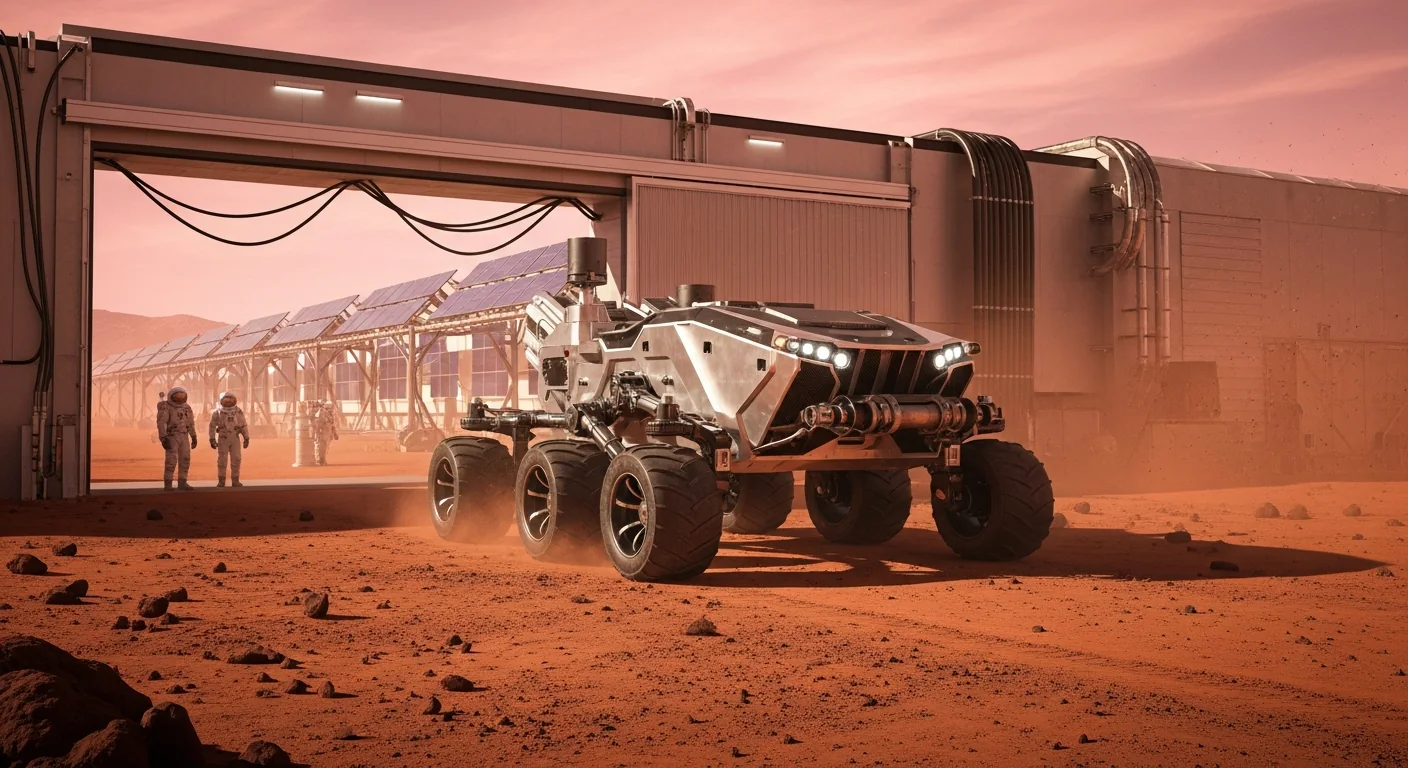
A rover that never left Mars. Aluminum chassis machined from Martian ore, basalt-fiber body panels, pressed metal wheels — all locally made. The electronics bay inside still contains imported processors and sensors, but everything you can see from the outside came from the ground beneath it.
Chassis and structural frame: the largest single component, and the best candidate for local fabrication. A rover chassis is an open frame holding a battery and electronics bay, six wheel assemblies, and a mast. Built from rolled aluminum or steel plate, cut and welded in a pressurized workshop, the chassis can be entirely local manufacture. Its launch mass is zero — it never left Mars.
Wheels: the spring-steel or titanium wire-mesh wheels on Curiosity and Perseverance were specifically designed to avoid pneumatic tires, which fail in Martian temperature extremes. A Martian metalworking facility can press and form steel or aluminum wheels from local plate and draw wire mesh for the tread. These are not precision components — they are formed metal parts.
Body panels, equipment housing, and rocker-bogie suspension arms: pressed aluminum sheet or basalt fiber composite panels, formed in simple stamping dies; machined aluminum linkages. All local. The rocker-bogie mechanism that lets Mars rovers climb over rocks — a set of pivot arms and differential bars — is machined aluminum: straightforward for a small workshop with basic CNC capability.
Solar panels: as with drones, locally manufactured solar panels change the power equation dramatically. A rover whose panels are manufactured on Mars can be larger, more capable, and replaced when dust-degraded without waiting for a resupply mission.
The electronics bay: batteries, motor drivers, navigation computer, camera suite, scientific instruments — Earth-sourced, for a long time. But they are now installed into a chassis, on wheels, behind panels that all came from the ground beneath them.
The rover that rolls out of the first Martian factory is Martian in everything you can see from outside. That means the fleet can grow without waiting for shipments. A broken rover is a rebuilding project, not a two-year wait.
The practical consequence: a settlement that can build its own rover chassis fields a fleet that scales with local manufacturing capacity, not with Earth's resupply schedule. A colony of ten people with a small metalworking facility can build and maintain more vehicles than the same colony waiting for delivery ever could.
Part nine
The dark factory.
One detail about Mars manufacturing separates it from every previous human industrialization: the factory is built and run by machines, and for the most part it is run by machines alone. The workforce gets there first, and a great deal of the work never needs a person in the room at all.
This is not hypothetical. Every realistic Mars settlement plan involves automated pre-deployment — cargo missions sent years before the first crew to pre-position supplies, establish power, and begin site preparation. A robotic construction and fabrication system, delivered by cargo and overseen from Earth across the communication delay, can begin producing structural components long before a human technician could walk into a workshop. For the first years, the robots are not assistants to a human workforce. They are the workforce.
That single fact changes the building itself — and it changes it in a way that turns out to be the most important cost lever on the entire planet. On Earth, a "lights-out" or dark factory — one that runs untended, with no lighting, no climate control, and no human shift — saves money on electricity and labor. On Mars, the same idea saves something far larger: it removes the need to keep anyone alive inside it.
Keeping a human comfortable on Mars is the single most expensive thing a settlement does. A space that people occupy has to be sealed and structurally reinforced to hold a full atmosphere against near-vacuum, filled with manufactured oxygen and nitrogen, heated from an ambient −60 °C to room temperature, scrubbed of CO₂, shielded from radiation, fitted with airlocks, and backed by redundant life support that is never allowed to fail. A robot needs none of it. Strip the people out of the production hall and every one of those systems — and the mass, power, and risk they represent — leaves with them.
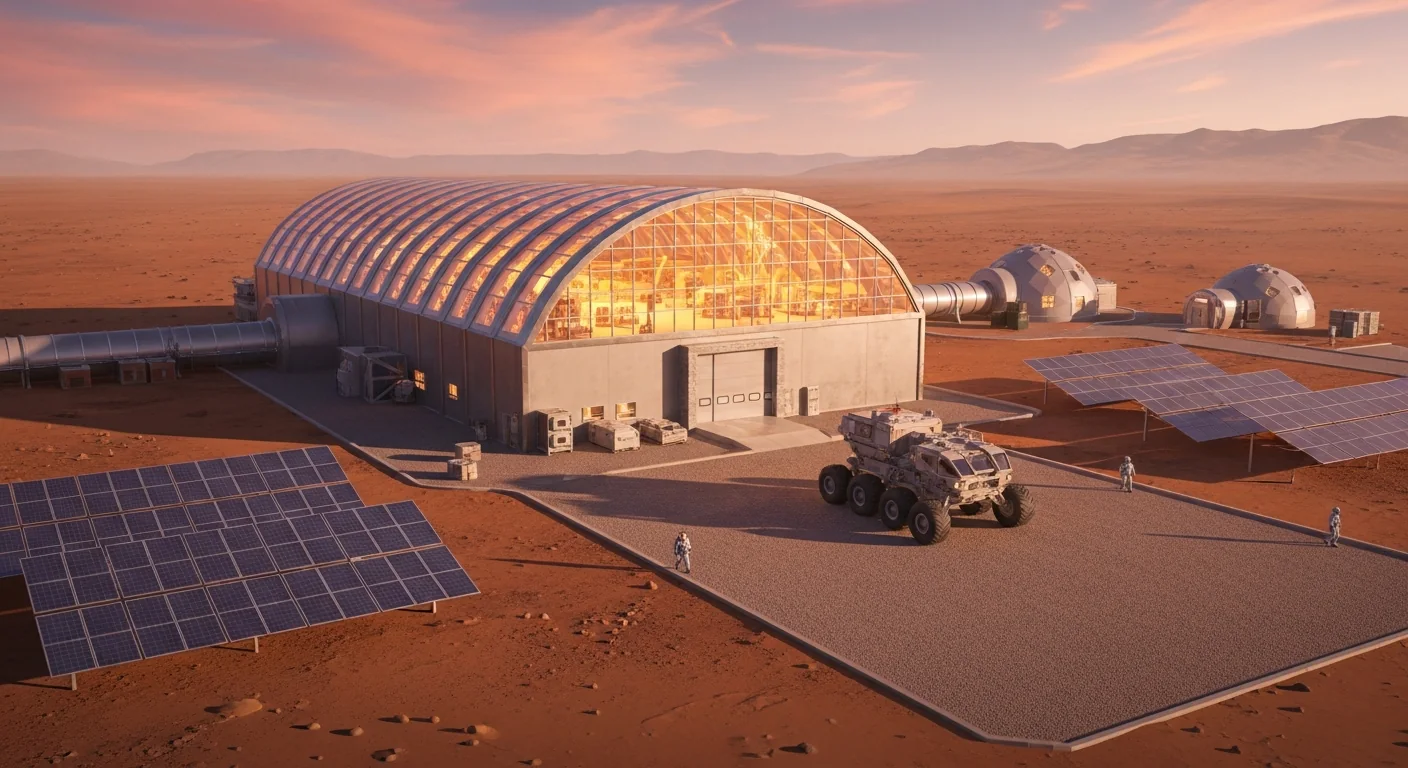
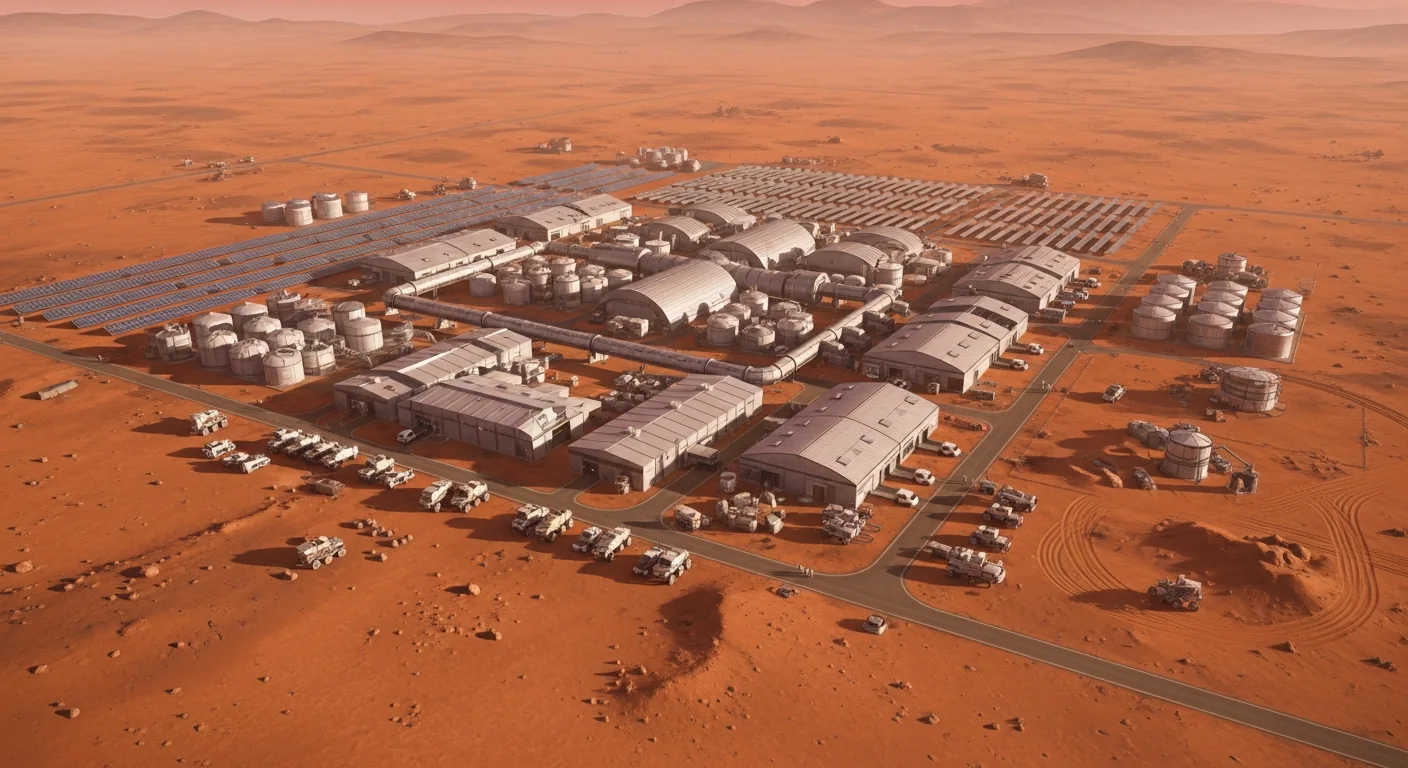
The factory from above. An early Martian manufacturing district seen from the air: open robotic works, a smelting facility, solar arrays, and material storage. Only the small human bays need pressure; the rest runs cold, dark, and untended. Most of it was built — and is run — by robotic systems, much of that before the first human crew arrived.
The architecture that emerges has two zones. A large dark zone — unpressurized, unheated, unlit — houses the heavy industry: the smelter, the regolith printers, the casting and sheet-forming lines, the rough machining. Robotic arms and gantries work there in the raw Martian environment, in the cold and the thin carbon-dioxide air, because none of it troubles a machine. Beside it sits a much smaller pressurized bay — the only part that carries the cost of life support — where humans or teleoperated hands do the delicate final work: integrating imported electronics, inspecting, repairing. Most of the factory's floor area, and nearly all of its tonnage of output, comes out of the part no person ever enters.
What is striking is that the Martian environment, lethal to people, is in several ways an asset to an uncrewed factory. The near-vacuum is a ready-made clean vacuum for processes that need one — thin-film deposition, electron-beam welding, sintering — which on Earth demand an expensive sealed chamber. The deep ambient cold is free cooling for the smelter and other high-energy processes that otherwise fight their own waste heat. And the absence of free oxygen means hot metalwork does not oxidize or burn: no rust, no fire risk, no inert shielding gas to truck in. A dark factory does not merely tolerate Mars. In places it exploits it.
The size of the colony is set by how many people it can keep breathing. The size of its industry is not. A dark factory grows with power and robots, not with life support — so the works can run far ahead of the town.
The fabrication technologies most amenable to early uncrewed implementation are: regolith 3D printing (already demonstrated at robotic scale on Earth), basic metal casting (pouring molten metal into a mold is a simple, supervisable operation), and automated welding (mature on Earth — and in vacuum it needs no shielding gas at all). Precision machining — cutting, drilling, threading — is more demanding but well within reach of the multi-axis robotic machining centers sold commercially today.
The sequence that emerges from a robotic-first, lights-out deployment: first, structural printing from regolith to build the factory's own expansion; second, smelting to produce iron and aluminum feedstock; third, casting and sheet-forming to turn that feedstock into structural blanks; fourth, robotic assembly of those blanks with imported precision components into finished machines. The factory bootstraps itself out of the ground, in the dark, and then builds the tools that expand its own capability — most of it before, and without ever needing, a person inside.
Part ten
The 50-year roadmap.
If the outlines of this technology are roughly correct — and they reflect the current consensus in planetary resources literature, even if timelines remain deeply uncertain — then Mars manufacturing unfolds in broadly three phases.
Phase 12030s–2040s
Import and assemble. Structural components printed from regolith and machined from imported aluminum stock. Imported electronics, motors, batteries, and sensors. First locally-assembled drones and rovers. Small robotic smelting operations beginning to produce rough iron from regolith. Solar power dominant; small nuclear reactors providing baseload for smelting and night-time operations.
Phase 22040s–2060s
Local metals and panels. Martian aluminum and iron production sufficient for all structural needs. First locally manufactured thin-film solar panels. Basalt-fiber composite manufacturing for lightweight drone and rover components. First locally drawn aluminum wiring. Drone frames, rover chassis, and body panels entirely Martian. Battery cells still largely imported but supplemented by a smaller number of locally chemically-produced alternatives. First locally assembled motors using imported rare-earth magnets wound with locally drawn wire.
Phase 32060s+
Approaching independence. If rare-earth deposits are confirmed on Mars (theoretically plausible, geologically unverified), motor manufacturing becomes fully local. If a chip fabrication facility can be bootstrapped — a massive undertaking requiring decades of specialized infrastructure — local electronics become possible for simple components. The fraction of a finished drone or rover sourced from Mars approaches 90 percent. A Mars colony can fully replenish and expand its vehicle fleet from local resources, independent of Earth's supply schedule entirely.
None of these phases has a guaranteed date. They depend on mission cadence, investment, the size of the human workforce, what the Martian surface turns out to contain, and the pace of automation and robotics development on Earth itself. But the technical pathway is clear, and the motivation — breaking dependence on a 26-month resupply cycle over 100 million miles — is compelling enough that every realistic long-duration Mars settlement plan includes in-situ manufacturing as a central pillar.
The frontier has always rewarded whoever showed up with the best tools and the means to make more of them. On Mars, that means the smelter is as important as the rocket.
Part eleven
What this means if you hold a parcel.
There is a connection between the question of Mars manufacturing and the question of land tenure that is worth being specific about.
The historical record of frontier settlement — explored in detail in our piece on where title comes from — suggests that the thing which consistently converted an act of possession into something recognized as ownership was demonstrated, documented, continuous improvement of the land. Clearing, building, mining, farming — the active transformation of a place. The claim alone, without the work, consistently failed. The claim backed by evidence of real activity on the ground consistently succeeded.
The homesteader's argument
A manufactured drone flying survey missions over a documented parcel is the oldest claim there is.
A settler whose parcel is the site of a regolith-printing facility, a solar collection array, or a workshop producing drones that survey the surrounding territory has a relationship with the ground that resembles, in the only historically meaningful sense, an actual claim. Not a database entry — a place being actively worked and documented.
We note plainly, as always: no legal title is conveyed on the Moon or Mars by any authority today. That may change. The history of frontier law is a history of sovereignty arriving after people already on the ground had worked out a prior arrangement. When it does arrive, the documentation you hold — of what ground, when surveyed, what work done on it — is the thing that precedes every paper title that has ever been granted on any frontier.
Martian manufacturing is what that looks like at a planetary scale. A drone built on Mars, from Martian materials, flying survey missions over a documented parcel of Arcadia Planitia — that is not a science-fiction image. That is the next frontier, operating exactly as every frontier before it.
The same machine that surveys the parcel was built on the parcel. The same metal that frames the rover came from the ground the rover explores. That circularity — the land feeding the tools that document the land — is the oldest loop in the history of settlement, played out now on a planet 100 million miles away.
The material compositions cited in this article are drawn from published analyses of Martian regolith by Mars Science Laboratory (Curiosity), Phoenix, Viking, and orbital spectroscopy missions (CRISM, OMEGA). Manufacturing process descriptions — molten oxide electrolysis, regolith sintering, thin-film silicon deposition — reflect published academic and institutional research as of 2026; none are operational on Mars today. Timeline estimates are speculative and are intended as rough sequencing guides based on technology readiness levels, not predictions. Descriptions of automated manufacturing systems reflect design concepts from multiple space agency and private-sector research programs. Nothing here is legal, financial, or investment advice. Spaceclaims conveys no legal title to land on the Moon, Mars, or any celestial body and guarantees no recognition of any claim. See our full legal & disclaimer page.
Important legal disclaimer
No conveyance of legal title. The 1967 Outer Space Treaty (Art. II) bars national appropriation of celestial bodies, and no sovereign, court, or land registry currently has jurisdiction to grant or enforce private title to land on the Moon, Mars, or any celestial body. Spaceclaims does not and cannot convey legal ownership or any presently-enforceable property right.
What you purchase. A claim-documentation and registry service — the preparation, notarization support, public publication, opposition-period adjudication, and continuous-possession recordkeeping of a good-faith homestead claim — together with a collectible certificate. It is a record of your claim and intent, not a title.
Not an investment; not a security. Your payment is not an investment of money in a common enterprise and carries no expectation of profit from our efforts. We make no representation as to resale value, appreciation, or return. The claim is not offered as a security and is not registered with the SEC, any state regulator, the Brazilian CVM, or any other authority.
No guarantee of recognition; no sovereignty; not legal advice. We model the process on frameworks in which documented good-faith possession was sometimes later recognized, but we do not guarantee any authority will ever recognize your claim. No Spaceclaims claim asserts national sovereignty. Nothing here is legal, tax, or financial advice.
We use cookies and analytics to understand how visitors use this site. You can accept or decline non-essential cookies. See our Privacy Policy.